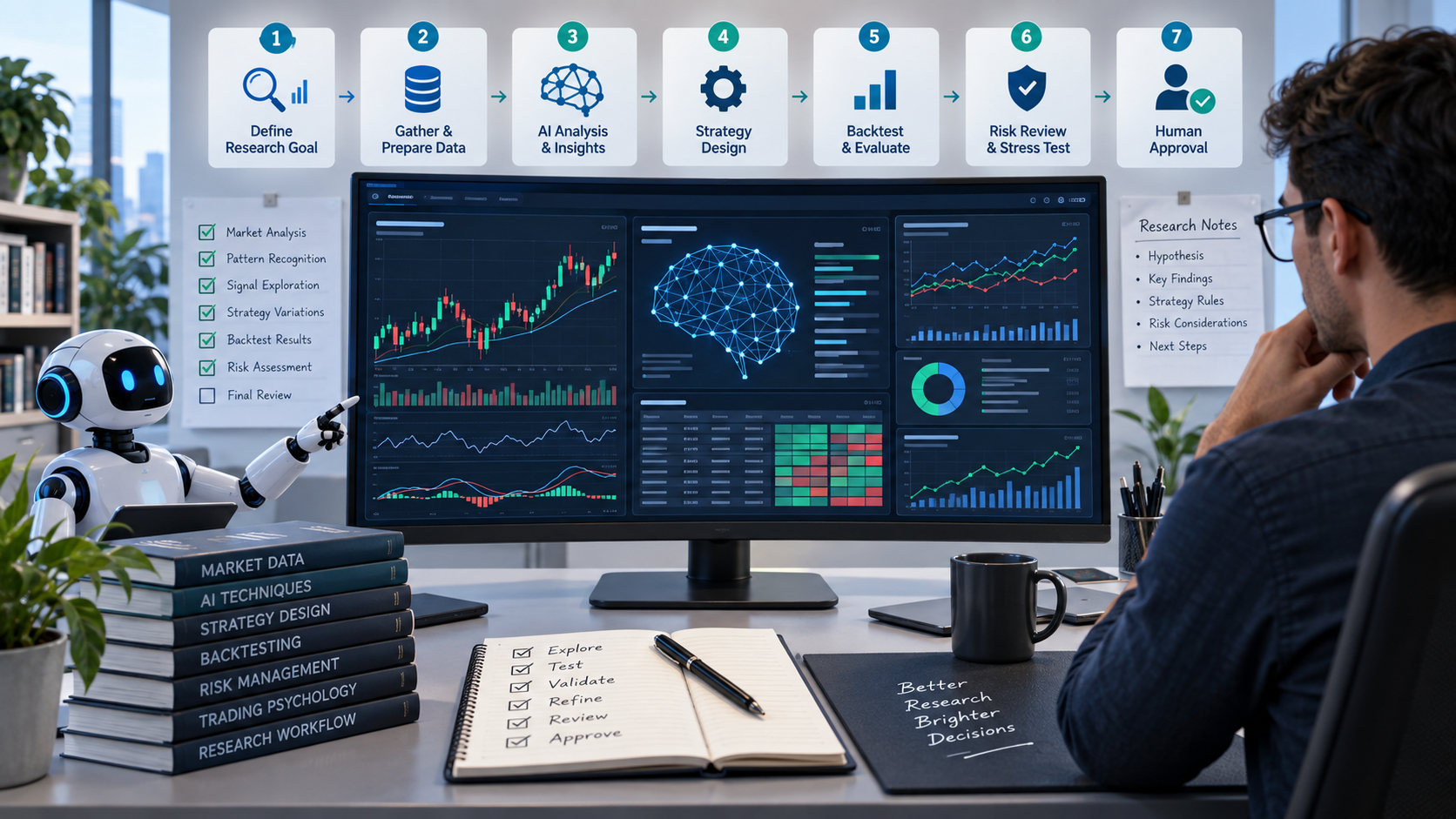
A vibe trading system is not a magic AI trading bot. A useful version is a research workflow: you describe a market question in plain language, the system gathers context, turns the idea into testable rules, checks historical behavior, reviews risk, and produces a report that a human can challenge before taking any action.
That distinction matters. AI can help organize trading research, but it should not be treated as proof that a trade is safe, profitable, or ready to execute. The goal is better research discipline, not automated confidence.
Quick answer
- Best purpose: use a vibe trading system to structure AI trading research, not to promise market predictions.
- Core workflow: prompt, data, rules, backtest, risk review, journal, and human approval.
- Best first setup: start with watchlist research and paper-testing before connecting anything to a brokerage account.
- Most important guardrail: every AI output should show sources, assumptions, and what would invalidate the idea.
- Biggest risk: overfitting a backtest until it looks impressive but fails in real market conditions.
What to know first
Vibe trading is a loose phrase, so Techmixer uses it carefully here. It means using natural-language prompts to guide trading research, not asking an AI model to gamble with money. A practical workflow should slow the process down enough to make the research repeatable.
This guide is for readers who want to research markets with AI tools, compare ideas, document assumptions, and build a safer review process. It is not financial advice, and it does not recommend buying, selling, or trading any security.
Vibe trading system components
| Layer | What it does | Good output | Human review needed |
|---|---|---|---|
| Prompt layer | Turns a plain-language question into a research task | Clear hypothesis, market, timeframe, and conditions | Check that the question is specific enough to test |
| Data layer | Collects market data, filings, news, macro context, and notes | Data source list with timestamps and limitations | Check data quality, freshness, and missing costs |
| Rules layer | Converts the idea into testable rules | Entry, exit, filter, and invalidation conditions | Check whether the rules match the original idea |
| Backtest layer | Runs the idea against historical data | Performance, drawdown, win/loss behavior, and edge cases | Watch for overfitting, survivorship bias, and unrealistic fills |
| Risk layer | Reviews downside, position size, concentration, and scenario risk | Risk notes and what could go wrong | Decide whether the idea is too fragile |
| Report layer | Summarizes the evidence into a research note | Readable thesis, sources, assumptions, and next steps | Approve, reject, or send back for more research |
7-step workflow to build a vibe trading system
1. Start with a research prompt, not a trade command
A weak prompt sounds like “find a good trade.” A stronger prompt asks for a defined research task: “Review whether large-cap semiconductor stocks showed stronger relative momentum than the Nasdaq 100 after earnings surprises over the past 12 months.” That gives the AI a job it can structure.
The prompt should include the market, timeframe, data needed, research angle, and what would invalidate the idea. This keeps the vibe trading system from drifting into vague confidence.
2. Gather market and context data
The system should separate price data, fundamental data, news, and notes. Platforms such as OpenBB documentation, spreadsheets, charting tools, or brokerage research exports can support this layer, depending on the reader’s setup.
The key requirement is traceability. If the system cannot show where the information came from, when it was pulled, and what is missing, the research is not ready for decisions.
3. Convert the idea into testable rules
AI can help turn a rough idea into conditions, but the rules should be plain enough for a person to audit. For example: “only test stocks above their 200-day moving average,” “exclude low-volume names,” or “compare results before and after earnings events.”
If the rules cannot be explained without jargon, the system should pause and rewrite them. A vibe trading system is useful only when it makes the research easier to inspect.
4. Run a backtest carefully
Backtesting can be useful, but it is also where many AI trading workflows become misleading. Tools such as TradingView Pine Script documentation can help users understand how strategy logic is written and tested, but the result still needs careful review.
Check whether the backtest includes realistic costs, slippage, date ranges, position sizing, and out-of-sample thinking. A strong-looking chart is not enough.
5. Add risk review before any conclusion
The risk review should ask simple questions: What is the largest drawdown? What happens in volatile markets? Does the idea rely on one unusual period? Would the result survive higher transaction costs? What would make the idea invalid?
This is also where AI fraud and hype warnings matter. Investor.gov warns that AI-generated information should be treated carefully when making investment decisions, and investors should be alert to promises of low-risk or guaranteed returns.
6. Produce a reproducible report
The final report should be boring and useful: hypothesis, data sources, rules, backtest notes, risk concerns, screenshots or charts, and a clear conclusion. A research report should say what was checked, what failed, and what still needs review.
This makes the workflow useful even when the answer is “do nothing.” Avoiding a weak idea is still a good research outcome.
7. Keep human approval at the end
The final step should be a human decision: approve for more research, reject, paper-test, or archive. The system should not hide uncertainty behind confident language.
For most readers, the safest starting point is a paper-research workflow. Do not connect AI-generated signals directly to live execution without serious controls, compliance review, and risk management.
Example workflow for a small research desk
- Prompt: “Research whether software stocks with rising free cash flow and positive price momentum held up better during market pullbacks.”
- Data: price history, volume, fundamentals, earnings dates, and market benchmark.
- Rules: define momentum, define free-cash-flow improvement, and define pullback periods.
- Backtest: compare screened group against benchmark over several time windows.
- Risk review: check concentration, drawdown, liquidity, and whether results rely on a single market cycle.
- Report: summarize evidence, assumptions, limitations, and next research steps.
Tools that can support the workflow
The tool stack does not need to be complicated. A practical setup can include a charting or backtesting environment, a spreadsheet or notebook, a market-data source, an AI assistant for summarizing and drafting, and a journal for decision review.
| Need | Example tool type | What to check |
|---|---|---|
| Chart and rule testing | TradingView or another charting/backtesting tool | Strategy logic, costs, date range, and limitations |
| Market data and research inputs | OpenBB, official filings, broker research, or data providers | Data freshness, licensing, survivorship bias, and missing values |
| Analysis workspace | Spreadsheet, notebook, or database | Whether results can be reproduced later |
| AI research assistant | Chat assistant or local workflow agent | Sources, assumptions, hallucination risk, and audit trail |
| Journal and review | Docs, Notion, Airtable, or spreadsheet log | Decision notes, rejected ideas, and lessons learned |
Internal Techmixer guides worth reading next
- AI Tools for broader AI software coverage.
- Software Guides for practical setup and workflow articles.
- Best Tools for comparison-style software guides.
- No-code AI workflow automation tools for building safer repeatable workflows.
- AI productivity tools for business and entrepreneurs for general productivity workflows.
Common mistakes to avoid
- Treating an AI summary as proof instead of a starting point.
- Changing rules repeatedly until the backtest looks good.
- Ignoring fees, slippage, liquidity, and realistic order fills.
- Using market data without checking the source or timestamp.
- Letting the system output a trade signal without a review log.
- Trusting any service that promises guaranteed AI trading profits.
Our take
A vibe trading system is most useful when it makes trading research more structured and less impulsive. It should help a reader ask better questions, preserve evidence, and notice weak assumptions. It should not create a false sense that AI can remove market risk.
Techmixer’s practical view is simple: use AI to organize research, compare scenarios, and write clearer notes. Keep financial decisions, compliance, and risk judgment with a human.
Last reviewed: 12 September 2026.
FAQ
What is a vibe trading system?
A vibe trading system is a structured AI-assisted research workflow that turns natural-language market questions into data checks, testable rules, backtests, risk reviews, and written notes.
Is vibe trading the same as automated trading?
No. Automated trading routes or places trades based on rules. A safer vibe trading workflow supports research and keeps a human in control of decisions.
What should beginners include first?
Start with a clear prompt, reliable data, testable rules, a backtest, risk review, a decision journal, and a final human approval step.
Why does AI backtesting need review?
Backtests can be distorted by overfitting, poor data, missing costs, survivorship bias, and unrealistic assumptions. Human review helps catch those problems.
Can AI predict the stock market reliably?
AI can help summarize information and test ideas, but it cannot guarantee future market direction or returns. Be cautious with any service claiming otherwise.