

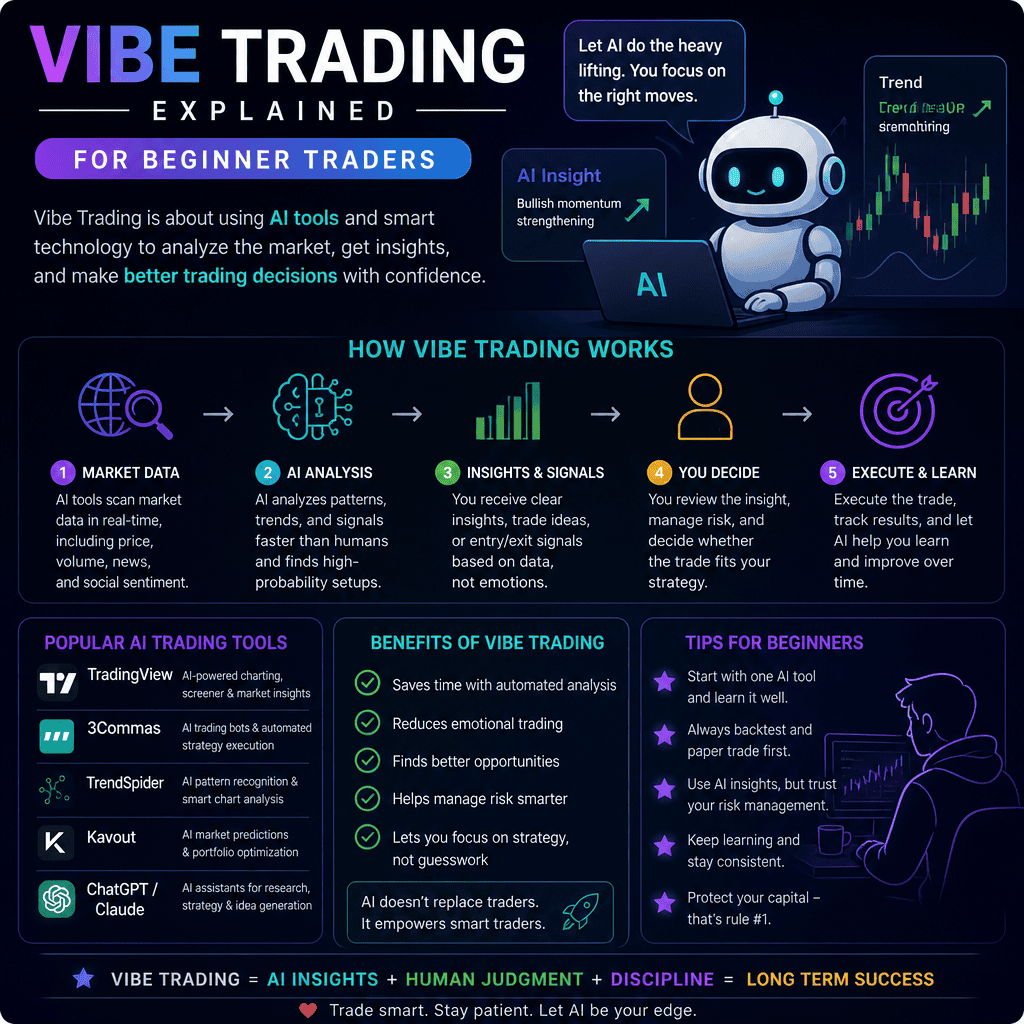
Vibe trading is a new, simpler way to use AI trading tools. Instead of writing code or spending hours on charts, users describe an idea in plain language and let AI help turn it into a testable strategy. That makes the concept useful for beginners, retail traders, and non-technical users who want to explore ai trading without becoming programmers. This article explains what vibe trading means, how an ai trading bot or assistant can support research, where backtesting fits in, and why human judgment still matters. Trading involves risk, and readers should always do their own research before acting on any strategy or market idea.
Direct Answer for Vibe Trading
Vibe trading means using AI to describe, build, test, and review trading ideas with natural language instead of complex coding. In practice, an AI trading assistant can help users turn plain-English rules into strategy logic, run backtests, highlight risk issues, and suggest improvements. It can make strategy research more accessible, but it should support decisions, not replace human judgment.
Key Takeaways
- Vibe trading uses natural language to make strategy creation easier for non-coders.
- AI can help with research, idea generation, rule formatting, and pattern review.
- Backtesting and risk checks are essential because a good-looking idea can still fail in real markets.
- Beginner and retail traders may benefit from faster learning and clearer workflows.
- AI trading tools can make mistakes, overfit data, or misread market context.
- Trading always involves risk, so users should verify outputs and do their own research.
For beginners, vibe trading means explaining a trading idea in everyday language and using AI to organize it into something more structured.
A simple example is: “Buy when the 20-day moving average crosses above the 50-day moving average, but only if volume is rising and risk per trade stays small.” A traditional workflow might require coding, spreadsheet work, or manual chart review. A vibe trading workflow asks AI to translate that idea into rules, test logic, and questions.
The main problem it solves is accessibility. Many retail traders have ideas but lack programming skills. Others can read charts but struggle to test whether a setup has worked historically.
People use vibe trading because it can help with:
- Clarifying vague ideas
- Converting ideas into rules
- Running structured backtests through connected platforms
- Stress-testing assumptions
- Reviewing risk before using real money
The concept is not magic. It does not remove market uncertainty. It simply lowers the barrier between “I have an idea” and “I can evaluate this idea more carefully.”
How Vibe Trading Works
Most vibe trading workflows follow a simple path.
- Describe the strategy in natural language.
The user explains an idea in plain English, such as entry rules, exit rules, timeframes, and asset class. - AI turns the idea into structured logic.
The system may convert the text into strategy rules, screening logic, or code for a specific platform. - The user reviews the rules.
This matters because AI can misunderstand vague instructions like “strong trend” or “low risk.” - Backtesting checks the idea on historical data.
The platform or connected tool tests how the rules would have behaved in past market conditions. - Risk checks highlight weak spots.
Users can review drawdowns, trade frequency, position sizing, or overfitting risks. - Refine and repeat.
AI can suggest cleaner rules, alternative filters, or simpler versions of the setup.
A practical scenario
A beginner retail trader wants to trade swing setups in ETFs but does not know coding. Instead of learning a scripting language first, they ask an AI trading assistant to help build a rules-based strategy from a basic idea. The assistant drafts the logic, points out missing exit rules, and suggests backtesting it before any live use. That saves time, but the trader still needs to judge whether the rules make sense.
Vibe Trading Key Features:
Natural language strategy creation
This is the core of vibe trading. Users can describe a setup in plain language rather than writing technical scripts from scratch.
Why it matters:
- It reduces the coding barrier
- It helps beginners think in rules, not guesses
- It speeds up the move from idea to testable strategy
A useful AI trading bot or assistant should ask follow-up questions when a rule is unclear. For example, “What counts as high volume?” is a better workflow than silently making assumptions.
Backtesting and strategy analysis
Backtesting checks how a strategy would have performed on historical data. This is one of the most important parts of ai trading research.
Why it matters:
- It shows whether a strategy is defined clearly enough to test
- It can reveal weak periods, excessive drawdowns, or overtrading
- It helps compare versions of the same idea
Backtesting does not predict future returns. It only shows how a strategy behaved on past data, which is useful but limited.
Risk checking and strategy refinement
Good vibe trading tools should do more than generate ideas. They should help users inspect risk.
Why it matters:
- Many bad strategies look good until position sizing or drawdowns are reviewed
- AI can flag incomplete logic, such as missing stop rules or unrealistic assumptions
- Users can simplify complex ideas that may be overfit
A practical decision framework is this: if the strategy is hard to explain clearly, hard to test consistently, and hard to size responsibly, it is probably not ready.
Pricing
Vibe trading is a concept, not one single product, so there is no universal price.
Costs depend on the platform you use for charting, AI assistance, data access, backtesting, or automation. Some tools may offer free plans or trials, while others use paid subscriptions or custom pricing.
Pricing may change over time, so readers should check the official website for the latest details.
If a platform also offers automation or an ai trading bot, users should verify whether live trading, broker integration, or historical data access costs extra.
Vibe Trading Pros and Cons
Pros
- Easier strategy creation for non-technical users
- Faster research and idea organization
- Can improve discipline by forcing clear rules
Cons
- AI can misunderstand vague instructions
- Backtests can create false confidence
- Users may rely too much on automation or generated output
Who Should Use It?
Vibe trading can be useful for:
- Beginners who want to learn strategy logic without coding first
- Retail traders who need a faster research workflow
- AI tool users who are comfortable prompting and reviewing outputs
- Non-technical readers who want structure instead of manual guesswork
It may be less suitable for:
- Traders who expect instant results without learning basics
- Users who want fully hands-off investing decisions
- Advanced quants who prefer custom models and direct code control
A good fit is someone who wants AI support but is still willing to review charts, verify rules, and question results.
Alternatives
Vibe trading is not the only way to research strategies. The best alternative depends on your skills and goals.
| Tool | Best For | Main Strength | Limitation |
|---|---|---|---|
| Manual chart analysis | Discretionary traders | Deep market context | Slow and harder to test consistently |
| TradingView with Pine Script | Retail traders learning rules-based trading | Popular charting and custom scripts | Requires scripting for advanced use |
| MetaTrader with Expert Advisors | Forex and CFD users | Strong automation ecosystem | More technical setup |
| QuantConnect | Advanced users and developers | Robust quantitative research environment | Steeper learning curve |
Manual chart analysis
- Best use case: Traders who prefer visual decision-making
- Main difference compared with vibe trading: More human interpretation, less automation
TradingView
- Best use case: Retail users who want charting plus scripted strategies
- Main difference compared with vibe trading: Strong chart tools, but many workflows still require Pine Script
MetaTrader
- Best use case: Users focused on algorithmic execution in supported markets
- Main difference compared with vibe trading: More centered on automated systems than natural language workflows
QuantConnect
- Best use case: Users who want deeper quantitative research
- Main difference compared with vibe trading: More powerful for developers, less beginner-friendly
Techmixer Verdict
Vibe trading is a useful idea because it makes ai trading more accessible. It can help beginners and retail traders turn rough market ideas into clearer rules, test those rules, and spot obvious weaknesses earlier. Its biggest value is not prediction. Its biggest value is structure.
Still, it is not a shortcut around risk, market complexity, or basic trading education. If you want full customization, institutional-grade research, or direct code control, alternatives like TradingView scripting, MetaTrader, or QuantConnect may be better. If you do explore vibe trading, verify how the platform handles data, backtesting assumptions, risk metrics, and broker integration before relying on it. Use AI as an assistant, not a substitute for judgment.
FAQ
What does vibe trading mean in simple terms?
Vibe trading means using AI to help describe and test trading strategies in normal language. Instead of coding every rule manually, a user explains the idea, and the AI helps organize it into something structured. It is best understood as an easier research workflow, not a guarantee of better trades.
Is vibe trading the same as using an ai trading bot?
Not exactly. An ai trading bot usually refers to software that may generate signals, automate actions, or execute trades. Vibe trading is broader. It focuses on using AI to create, analyze, and improve strategy ideas through natural language. A bot can be part of that workflow, but the concepts are not identical.
Can beginners use vibe trading without knowing coding?
Yes, that is one of its main advantages. Vibe trading can help beginners explore rules-based trading without learning a programming language first. However, users still need to understand basic concepts like entries, exits, position sizing, and drawdowns. AI lowers technical barriers, but it does not remove the need for learning.
Does backtesting in vibe trading guarantee future results?
No. Backtesting only shows how a strategy would have behaved on past data under specific assumptions. Markets change, execution differs, and historical patterns may not repeat. That is why backtesting should be treated as one research tool, not proof that a strategy will work in live conditions.
What are the biggest risks of ai trading tools?
The biggest risks include unclear prompts, faulty assumptions, overfitted strategies, incomplete risk rules, and overconfidence. AI can produce convincing outputs that still contain errors. In ai trading, the danger is often not obvious nonsense. It is plausible-looking logic that users fail to question carefully.
Should traders let AI make decisions automatically?
For most beginners and retail traders, AI should support decision-making rather than replace it. Human oversight matters because markets involve context, news, slippage, and risk tolerance that models may not capture well. Automation may be useful in some workflows, but it should be monitored and understood before live deployment.
Sources
- U.S. Securities and Exchange Commission (SEC): https://www.sec.gov/
- FINRA Investor Insights: https://www.finra.org/investors
- CFTC Customer Education: https://www.cftc.gov/LearnAndProtect
- NFA Investor Resources: https://www.nfa.futures.org/investors/index.html
- TradingView: https://www.tradingview.com/
- MetaTrader: https://www.metatrader5.com/
- QuantConnect: https://www.quantconnect.com/
Pricing, features, and availability may change. Readers should verify the latest details on the official website.

The focus on turning plain-language ideas into testable strategies is especially useful for beginners who may not know how to code. I also appreciate the reminder that AI trading tools can help with backtesting and risk checks, but shouldn’t replace human judgment or careful research.