The artificial intelligence landscape in 2026 has officially moved past the era of simple chatbots. We have entered the era of the Multi-Agent Organization.
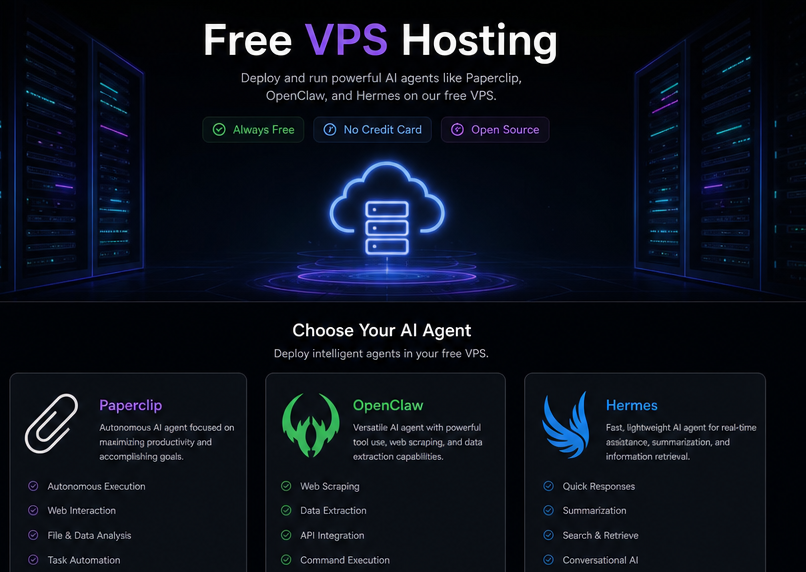
Right now, massive open-source communities are raving about a powerful trio of software: Paperclip (the organizational “Company OS”), OpenClaw (the autonomous worker agent), and Hermes (the deep-research specialist). When you connect these three together, you aren’t just running a script—you are effectively building a completely autonomous, digital company that works for you around the clock.
However, there is a massive catch that almost every new user runs into: To run an automated company, your agents need to be online 24 hours a day, 7 days a week. If you install Paperclip, OpenClaw, and Hermes on your personal MacBook or Windows laptop, your digital company completely shuts down the second you close the lid or go to sleep. Nobody wants to leave their personal computer running all night, burning electricity and wearing out their battery, just to keep an AI agent awake.
That is exactly why you need a Virtual Private Server (VPS). In this comprehensive, beginner-friendly guide, we are going to break down exactly what it takes to host this powerful AI ecosystem. We will cover the specific hardware you need, the best completely free cloud providers (like Oracle and AWS), and why a budget-friendly premium option like Hostinger might be the ultimate secret weapon for your AI empire.
Understanding Your AI Stack: The Desk vs. The Company
Before we look at server specs, you must understand exactly what you are trying to host. If you try to run all of this without understanding how they interact, your server will crash.
1. Paperclip (The Boss & The Infrastructure)
Paperclip (found at Paperclip.ing) is not an AI model itself. It is a massive organizational layer. It acts as the “Operating System” for your virtual company. It features an organizational chart, reporting hierarchies, budget controls, and an unchangeable audit log. Paperclip requires a Node.js server and a robust PostgreSQL database to remember everything your agents do. Because it acts as the central brain, Paperclip requires the most stable server environment.
2. OpenClaw (The Star Employee)
OpenClaw is your continuous, autonomous worker. It is the agent that actually goes out and reads your emails, manages your files, and executes complex tasks. While OpenClaw can run on its own, it shines brightest when it is “hired” as an employee inside Paperclip. It connects via a continuous adapter, waking up to complete tasks assigned by the Paperclip CEO.
3. Hermes (The Deep Researcher)
Hermes Agent is a specialized AI known for deep, complex research and data parsing. Thanks to native integration, Hermes hooks directly into Paperclip seamlessly. It can read massive amounts of data, pause its session, and resume perfectly during its next “Heartbeat” (scheduled work shift).
The Goal: You want a server that is powerful enough to run the Paperclip database, alongside both OpenClaw and Hermes, without freezing up.
What Hardware Do You Actually Need to Run This Full Stack?
Running a single instance of OpenClaw is fairly lightweight. However, running Paperclip + OpenClaw + Hermes + a PostgreSQL Database is a completely different beast. You are running a multi-agent corporate infrastructure.
If you choose an underpowered server, your database will crash, your agents will lose their memory, and your digital company will go bankrupt. Here is the absolute minimum you should look for when choosing a VPS:
2 to 4 Virtual CPUs (vCPUs): You need multiple cores. One core will constantly be handling the Paperclip interface and the PostgreSQL database, while the other cores will be busy executing the live Python scripts for OpenClaw and Hermes.
Memory (RAM): 4 GB of RAM is the absolute bare minimum, but 8 GB is highly recommended. This is the biggest hurdle. Paperclip’s database takes up memory, and each AI agent running concurrently will consume about 1 GB to 2 GB of RAM each.
Storage: 30 GB to 50 GB of disk space. This covers the Docker images, your operating system (like Ubuntu), your PostgreSQL database storage, and the endless logs your agents will generate.
Stable Bandwidth: Your agents will constantly be talking to the internet, fetching websites, and pinging AI APIs (like OpenAI, Anthropic, or DeepSeek).
Docker/Linux Support: Paperclip and these agents are universally designed to be deployed using Docker containers on a Linux server.
With these heavy requirements in mind, let’s look at the free VPS cloud platforms and see which ones survive the stress test.
Oracle Cloud (The Only True Free Option for the Full Stack)
If you have spent any time in the self-hosting communities, you have undoubtedly heard of Oracle Cloud. When it comes to running the entire Paperclip, OpenClaw, and Hermes stack for free, Oracle is effectively your only option.
What You Get on the Free Plan:
Oracle’s “Always Free” tier provides specs that most competitors charge $20 to $40 a month for.
Up to 4 ARM-based Ampere A1 CPU Cores
24 GB of RAM
200 GB of Block Storage
10 Terabytes (TB) of outbound data transfer per month
You read that correctly: 24 GB of RAM completely free, forever. You can easily install the Paperclip Docker container, spin up your PostgreSQL database, run OpenClaw, run Hermes, and still have 18 GB of RAM left over to hire ten more AI agents.
The Catch
While the specs are unmatched, actually getting an Oracle free instance can be a massive nightmare. Because the offer is so generous, Oracle’s free servers are frequently “out of capacity” in popular regions (like the United States and Europe). You may have to try clicking the “Create Instance” button repeatedly over several weeks just to get a server. Additionally, Oracle is known to aggressively delete free servers if they sit completely idle for 7 consecutive days—though your active Paperclip company should prevent this.
Verdict: The undisputed king of free hardware. If you have the patience to fight the capacity errors, it runs the entire multi-agent stack flawlessly.
Microsoft Azure (The 12-Month Starter Pack)
Microsoft Azure is an incredibly mature, enterprise-grade cloud ecosystem. If you want to get your AI company online quickly without fighting Oracle’s capacity errors, Azure offers a fantastic 12-month window.
What You Get on the Free Plan:
When you create a new Azure account, Microsoft gives you $200 in credits for the first 30 days. After that, upgrading to a “Pay-As-You-Go” account unlocks 12 months of free access to select virtual machines.
You need to specifically look for the ARM-based B2pts v2 instance. This specific free tier grants you 2 vCPUs and 4 GB of RAM.
The Catch
4 GB of RAM is enough to run Paperclip, your database, and OpenClaw simultaneously. However, if you try to push Hermes to do heavy multi-threaded research at the exact same time, you might max out the server memory. Furthermore, you must be extremely precise during setup. Selecting the wrong disk type (Premium SSD instead of Standard) will instantly bypass the free tier and charge your card. And remember, the server is only free for 365 days.
Verdict: A solid 1-year free trial to build your Paperclip company, provided you stick to exactly 4GB of RAM and are careful with billing.
Amazon Web Services (AWS)
AWS is the backbone of the internet, but its free tier was not designed with multi-agent AI frameworks in mind.
What You Get on the Free Plan:
The standard AWS free tier gives you a T2.micro or T3.micro instance, which provides 1 vCPU and 1 GB of RAM.
Let us be completely clear: 1 GB of RAM cannot run Paperclip, OpenClaw, and Hermes. The server will crash the moment you try to build the Docker containers.
AWS does occasionally offer a separate free trial for their ARM-based T4g.small instance, which grants 2 vCPUs and 2 GB of RAM. You might be able to squeeze a lightweight version of Paperclip and a single OpenClaw agent onto 2 GB of RAM if you configure your Linux swap files perfectly, but it will be a severely laggy experience.
Verdict: AWS free tier is simply too small for this multi-agent stack. It is only viable if you skip Paperclip entirely and only run one standalone CLI agent.
Google Cloud Platform (GCP)
Google Cloud offers a lifetime “Always Free” tier, which sounds great on paper until you look at the specifications.
Google allows you to run one e2-micro virtual machine per month for free in specific US regions. This includes 2 Shared vCPUs and 1 GB of RAM. Just like AWS, 1 GB of RAM is an instant failure for hosting a PostgreSQL database alongside multiple AI agents.
Worse yet, Google strictly limits your outbound bandwidth to just 1 GB of data per month. Because Paperclip, OpenClaw, and Hermes are constantly scraping the web, making API calls to Claude/OpenAI, and syncing logs, you will burn through 1 GB of data in a matter of days. Once you hit that limit, you will be billed for every kilobyte.
Verdict: Do not attempt to run the Paperclip multi-agent stack on the Google Cloud free tier.
The Ultimate Solution: Why a Premium VPS (Hostinger) is the Best Choice
While free tiers are fantastic for experimenting, trying to run a complex, multi-agent AI company on free hardware is often a massive headache. You have to deal with out-of-capacity errors (Oracle), expiring trials (Azure), or servers crashing from lack of RAM (AWS/Google).
If you are serious about letting Paperclip, OpenClaw, and Hermes run your digital life or automate your real-world business, investing in a low-cost, premium VPS is the smartest thing you can do.
Hostinger is highly recommended by developers for running self-hosted AI agents. Here is why it completely outperforms the free options:
1. Incredible Specs for the Price
Hostinger’s KVM 2 plan provides 2 vCPUs, 8 GB of RAM, 100 GB of lightning-fast NVMe SSD storage, and a massive 8 TB of bandwidth for just a few dollars a month. 8 GB of RAM is the absolute sweet spot. It allows you to run the Paperclip organization layer, the PostgreSQL database, OpenClaw, Hermes, and still have plenty of room to install a third or fourth agent without your server breaking a sweat.
2. Built-in AI Server Assistant (Kodee)
Installing Paperclip and configuring multiple Docker containers can be intimidating for beginners. Hostinger integrates an AI assistant named “Kodee” directly into your server dashboard. If you don’t know the exact terminal commands to install Docker, set up your firewall, or configure your database, you can simply ask Kodee to generate and execute the commands for you directly in the browser.
3. Absolute Stability and Control
With a paid Hostinger VPS, you have full root access. Your server is guaranteed to be online. You never have to worry about a cloud provider suddenly deleting your instance because it was “idle,” and you don’t have to fight a million other users for capacity.
4. Seamless Scalability
As your AI company grows, you might want to stop using external APIs (like OpenAI) and start hosting your own local Large Language Models (like Llama 3) to save money and ensure absolute privacy. With Hostinger, you can seamlessly upgrade your server to a KVM 4 or KVM 8 plan (up to 32 GB of RAM) with a single click, without ever having to rebuild your Paperclip configuration.
Watch Hostinger VPS Introducation Vdeo Here
Final Verdict: Building Your AI Empire
The barrier to entry for AI automation has completely vanished. The tools are free and open-source, and the infrastructure is cheaper than a cup of coffee.
If you have zero budget and infinite patience, sign up for Oracle Cloud, cross your fingers, and try to claim your free 24 GB RAM instance to host your entire stack.
However, if you value your time, want absolute stability, and are ready to deploy Paperclip, OpenClaw, and Hermes today without the technical headaches, spending a few dollars a month on a Hostinger KVM 2 VPS is the best investment you can make for your automation workflow.
Set up your server, launch your digital company, and let your AI agents get to work.